The CA Foundation 90 day study plan for 250+ marks
PrepPortal10 min read
A CA Foundation 90 day study plan only works if it is honest about three numbers: the hours you can actually give it, the marks each chapter is actually worth, and the date the attempt falls on. This one assumes 8.5 study hours a day for thirteen weeks, and it is written to clear 250 out of 400 — not to "finish the syllabus".
The plan at a glance:
- 8.5 hours a day, split Accounting 2.5, Business Laws 2, Quantitative Aptitude 2.5, Business Economics 1.5.
- A mark budget, not a hope: Accounting 65+, Business Laws 55+, Quantitative Aptitude 60+, Business Economics 70+, which sums to 250.
- Days 1–42: every paper pushed past the 40 per cent cut-off.
- Days 43–70: the high-weightage chapters that build the aggregate.
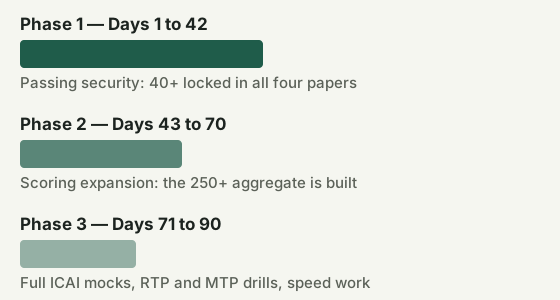
- Days 71–90: full ICAI mocks, RTP and MTP drills, speed conditioning.
What this CA Foundation study plan assumes
Three things follow from those numbers:
- Coverage is ranked, not uniform. Every chapter below sits in a tier by return on investment. Tier 1 gets the hours it deserves, Tier 3 gets its basics and nothing more.
- The 250 is budgeted before it is chased. Accounting 65+, Business Laws 55+, Quantitative Aptitude 60+, Business Economics 70+. Those four targets add up to 250.
- The ninety days run in three phases, and the first one is defensive.
| Phase | Days | What it is for |
|---|---|---|
| Phase 1 | Days 1–42 | Passing security — locking 40+ in all four papers |
| Phase 2 | Days 43–70 | Scoring expansion — building the 250+ aggregate |
| Phase 3 | Days 71–90 | Full mocks, speed conditioning, ICAI RTP and MTP drills |
The ICAI asks for 40 per cent in each paper and 50 per cent in aggregate, so Phase 1 deliberately refuses to chase a high score anywhere. Four papers at 40+ first; only then is any one of them pushed towards 65.
The CA Foundation daily time table: 8.5 hours by paper
| Paper | Daily time | The split |
|---|---|---|
| Paper 1 — Accounting | 2.5 hours | 30 min formats and concepts + 2 hr written problems |
| Paper 2 — Business Laws | 2.0 hours | 1 hr 15 min provisions + 45 min case-study writing |
| Paper 3 — Quantitative Aptitude | 2.5 hours | 30 min formulae and tricks + 2 hr timed MCQs |
| Paper 4 — Business Economics | 1.5 hours | 1 hr deep reading + 30 min MCQ drilling |
Paper 1 — Accounting, 2.5 hours
Thirty minutes on formats and concepts, then two full hours of hand-written problem solving. Write every solution out before you look at the answer. Reading a worked solution and agreeing with it is not practice — it is the single most common reason a student who knows the chapter still loses marks on presentation, working notes and format.
Paper 2 — Business Laws, 2.0 hours
An hour and a quarter memorising provisions — the section, the exact wording of the definition, the exceptions — then forty-five minutes writing case studies longhand in one fixed structure: the issue, the provision that governs it, the facts applied to that provision, the conclusion. The structure is what earns the marks, because the examiner has to be able to find the provision. Business Laws has chapter-wise MCQ practice in the PrepPortal CA Foundation course, which is a cheap way to check at night that a provision actually stuck.
Paper 3 — Quantitative Aptitude, 2.5 hours
Thirty minutes on the formula sheet and the shortcuts, then two hours of timed MCQs on a physical calculator, not an on-screen one. Paper 3 is objective with 0.25 negative marking, so speed and the decision to leave a question alone are part of the syllabus, not a matter of temperament.
Paper 4 — Business Economics, 1.5 hours
An hour of deep reading with the attention on graphs and exceptions, then thirty minutes of fast MCQ drilling. Economics is the cheapest 70 on the paper if the diagrams are learnt as diagrams rather than as paragraphs about diagrams.
CA Foundation chapter-wise weightage: where the 250+ marks sit
The figures below are planning weights — the marks these areas have tended to carry — and not a promise about any one paper. Confirm the current pattern on icai.org before you plan around them.
Paper 1 — Accounting (target 65+)
Tier 1, highest return:
- Company Accounts — Issue of Shares and Debentures (~15–20 marks)
- Final Accounts of Sole Proprietors (~10–15 marks)
- Partnership Accounts (~15 marks)
- Depreciation and Bank Reconciliation Statements (~10–14 marks)
Tier 2, once Tier 1 is solid: Financial Statements of Not-for-Profit Organisations, Rectification of Errors, Bills of Exchange, Accounts from Incomplete Records.
Tier 3, basics only: Theoretical Framework, Inventory valuation.
Paper 2 — Business Laws (target 55+)
Tier 1, highest return:
- The Indian Contract Act, 1872 (20–30% of the paper)
- The Companies Act, 2013 (~15–20 marks)
Tier 2: The Sale of Goods Act, 1930 (~15–20 marks), The Indian Partnership Act, 1932 (~15 marks).
Tier 3: The Negotiable Instruments Act, 1881 (~10–15 marks), The LLP Act, 2008 (~5 marks), the Indian Regulatory Framework (~5 marks).
Paper 3 — Quantitative Aptitude (target 60+)
Tier 1 — 44 to 50 marks between them:
- Logical Reasoning (the full 20 marks)
- Time Value of Money (12–15 marks)
- Measures of Central Tendency and Dispersion (12–15 marks)
Tier 2: Ratio, Proportion, Indices and Logarithms (5–6 marks), Sequence and Series (4–6 marks), Correlation and Regression (5–7 marks), Statistical Description of Data (5–6 marks).
Tier 3, selective — learn the basics and move on: Calculus, Theoretical Distributions, Permutations and Combinations.
Paper 4 — Business Economics (target 70+)
Tier 1, highest return:
- Theory of Demand and Supply (~10–12 marks)
- Theory of Production and Cost (~10–12 marks)
- Price Determination in Different Markets (~10–12 marks)
- Determination of National Income (~10–12 marks)
Tier 2: Public Finance, Money Market, International Trade.
Tier 3: the Indian Economy overview, Business Cycles.
The 13-week CA Foundation syllabus progression
Four papers move in parallel every week. The tables scroll sideways on a phone.
Phase 1 — Days 1 to 42: passing security
| Week | Accounting | Business Laws | Quantitative Aptitude | Business Economics |
|---|---|---|---|---|
| W1 | BRS + Depreciation | Regulatory Framework + Contract Act (nature, offer and acceptance) | LR: number series, coding–decoding, odd man out + ratio and proportion | Basics of economics + demand analysis and elasticity |
| W2 | Rectification of Errors + Bills of Exchange | Contract Act (capacity to contract, consideration) | LR: direction sense + indices and logarithms | Consumer behaviour (utility, indifference curves) + supply analysis |
| W3 | Final Accounts of Sole Proprietors (trading, P&L, balance sheet) | Contract Act (free consent, legality of object) | LR: seating arrangements + equations (linear and quadratic) | Theory of production (laws of production, returns to scale) |
| W4 | Company Accounts: issue, forfeiture and re-issue of shares | Contract Act (void agreements, contingent and quasi contracts) | LR: blood relations — completes Logical Reasoning | Theory of cost (short-run and long-run curves) |
| W5 | Company Accounts: debentures + bonus and rights issue | Contract Act (performance, discharge, breach) | Time Value of Money part 1 (simple and compound interest, annuities) | Markets: perfect competition and monopoly |
| W6 | Partnership: basics and admission of a partner | Companies Act, 2013 (basics, incorporation, MoA and AoA) | Time Value of Money part 2 + linear inequalities | Markets: monopolistic competition, oligopoly + business cycles |
Milestones to hold yourself to:
- W1: the routine itself is the deliverable — eight and a half hours, four papers, every day.
- W3: first full-chapter tests, sat under time.
- W4: Logical Reasoning finished. That is 20 marks of Paper 3 locked while everyone else is still deciding where to start.
- W5: 30+ secured in Business Laws and in the maths half of Paper 3.
- W6: Phase 1 complete — the 40 per cent cut-off is covered in all four papers. Everything after this is upside.
Phase 2 — Days 43 to 70: scoring expansion
| Week | Accounting | Business Laws | Quantitative Aptitude | Business Economics |
|---|---|---|---|---|
| W7 | Partnership: retirement, death, dissolution of firm | Companies Act, 2013 (share capital, management, meetings) | Statistical Description of Data + central tendency (mean, median, mode) | Determination of National Income (concepts and aggregates) |
| W8 | Financial Statements of Not-for-Profit Organisations | Sale of Goods Act, 1930 (formation, conditions and warranties) | Measures of dispersion (SD, variance, quartile deviation) | Keynesian theory of national income determination |
| W9 | Accounts from Incomplete Records (single entry) | Sale of Goods Act, 1930 (transfer of ownership, unpaid seller) | Sequence and series (AP and GP) + correlation analysis | Public finance: fiscal functions, public revenue and expenditure |
| W10 | Inventories + accounting for special transactions | Indian Partnership Act, 1932 (nature, relations of partners, dissolution) | Regression analysis + index numbers | Money market: demand and supply of money, monetary policy |
Milestones to hold yourself to:
- W8: the high-weightage accounting chapters are mastered, not merely read.
- W9: your aggregate capability crosses 220+ on honest self-tests.
- W10: Phase 2 complete — one hundred per cent of the syllabus this plan targets for 250+ is finished.
Phase 3 — Days 71 to 90: mocks and speed conditioning
| Week | Accounting | Business Laws | Quantitative Aptitude | Business Economics |
|---|---|---|---|---|
| W11 | Theoretical Framework + fast-track revision of Module 1 | Negotiable Instruments Act, 1881 + LLP Act, 2008 | Sets, relations and functions + basic permutations and combinations | International trade + Indian economy overview |
| W12 | Full subject revision + ICAI papers of the last three years | Full subject revision + case-study speed drills | Probability basics + full formula revision | Full fast-track review + graph and formula cheat sheets |
| W13 | 100-mark ICAI mock 1 and 2 | 100-mark ICAI mock 1 and 2 | 100-mark MCQ mock 1 and 2 | 100-mark MCQ mock 1 and 2 |
Milestones to hold yourself to:
- W11: the ICAI Revision Test Papers for the attempt are covered.
- W12: two full 100-mark mocks per subject, marked honestly.
- W13: final polish and weak-area patching only. No new chapters.
Sit the W13 mocks at the clock the real paper runs on: 2 PM to 5 PM for Accounting and Business Laws, 2 PM to 4 PM for Quantitative Aptitude and Business Economics, with the 0.25 negative marking applied. A mock sat at 11 AM with a pause for tea measures your knowledge; a mock sat at 2 PM measures your paper.
Five habits this 90 day plan depends on
- Hand-write full solutions. Auditing a printed solution teaches recognition, not recall. The exam asks for recall.
- Use a physical calculator for Paper 3 from day one, so the keypad is muscle memory by W13.
- Write every law answer in the same structure — issue, provision, facts, conclusion — until it needs no thought.
- Respect negative marking in practice. Guess in a mock the way you intend to guess in the exam, and count the cost.
- Patch weak areas last, not first. Phase 3 is for the chapters your mock scores name, not the ones that feel uncomfortable. If you practise in the app, the progress view already names them for you — the FAQ explains how that is worked out.
Practising the CA Foundation syllabus on PrepPortal
All four papers are open in the CA Foundation course: chapter-wise MCQ practice and revision notes for Accounting, Business Laws, Quantitative Aptitude and Business Economics, with the notes for a chapter sitting beside the questions on it. The doubt board is open to every Foundation student, which makes it the fastest place to settle the sub-section that will not go in. The FAQ covers how practice, streaks and progress work.
Frequently asked questions
Is 90 days enough to prepare for CA Foundation?
It is enough to clear the exam and enough to score well, but only if the time is ranked rather than spread evenly. Ninety days at 8.5 hours a day is roughly 765 study hours, which covers the whole syllabus once and the high-weightage half of it three times. What it does not allow is finishing every chapter to the same depth.
How many hours a day does this plan need?
Eight and a half, split 2.5 hours for Accounting, 2 hours for Business Laws, 2.5 hours for Quantitative Aptitude and 1.5 hours for Business Economics. If you have fewer hours, cut the Tier 3 chapters first and keep the daily split in the same proportions rather than dropping a paper entirely.
Which CA Foundation chapters carry the most marks?
Company Accounts and Partnership in Accounting, the Indian Contract Act in Business Laws, Logical Reasoning and Time Value of Money in Quantitative Aptitude, and Demand, Production and Cost, Market Structures and National Income in Business Economics. Those areas alone account for most of a 250 aggregate.
Can I realistically score 250 out of 400 in three months?
Yes, if the marks are budgeted per paper before you start. This plan targets 65 in Accounting, 55 in Business Laws, 60 in Quantitative Aptitude and 70 in Business Economics, which sums to 250. Economics and Logical Reasoning are the cheapest marks on the paper, which is why they are protected first.
Should I skip chapters in the CA Foundation syllabus?
Skip nothing outright, but read Tier 3 chapters for their basics only and never let them displace Tier 1 practice. The risk of a two-mark theory question you cannot answer is far smaller than the risk of losing fifteen marks on Company Accounts because the problems were never written out by hand.
Practise this on PrepPortal.
The CA Foundation course is open in the app today: chapter-wise MCQ practice that marks each question the way the ICAI paper does, revision notes beside the questions, and a doubt board where other Foundation students answer. Signing in with Google is the whole of it — the FAQ covers the rest.
PrepPortal is not affiliated with, endorsed by, or an agent of the ICAI. Exam dates, paper patterns and the syllabus are set by the ICAI and can change — always confirm them on icai.org before you plan around anything here.